KooeeKeis Australian Cobberdogs ~ Ethical Family Breeder in WA

Australian Cobberdog Information Hub - Cobberdog Corner
Welcome to Cobberdog Corner — our dedicated Australian Cobberdog information hub created to educate, empower, and support families at every stage of their journey.
Choosing an Australian Cobberdog is a significant and joyful decision. Whether you are researching the breed, exploring ethical breeding practices, preparing for a new puppy, or simply wanting to understand the temperament and care needs of this remarkable companion dog, this page brings together trusted, experience-based information in one organised space.
At KooeeKeis Australian Cobberdogs, we believe informed families make confident decisions. Our Cobberdog Corner educational hub covers essential Australian Cobberdog topics including health testing, allergy considerations, grooming, early puppy training, enrichment, therapy suitability, responsible breeding standards, and what truly defines an ethical breeder.
very article within this hub has been thoughtfully written to reflect our hands-on experience, professional development, and daily life with Australian Cobberdogs. From understanding coat types and temperament traits to learning how structured enrichment prevents behavioural issues, our goal is to provide clear, practical guidance that supports both puppies and their future families.
Education is part of ethical breeding. Before a puppy ever leaves our home, we invest in early socialisation, temperament observation, and foundational training. We also believe that families deserve transparent information about health screening, breed suitability, and long-term care. This Australian Cobberdog information hub allows us to share that knowledge openly.
Below you will find a growing collection of educational articles designed to answer common questions, address misconceptions, and provide responsible guidance. We encourage you to explore each topic and return often as Cobberdog Corner continues to expand.
Because when we say “From Our Arms to Yours,” education is part of that promise.

Explore Our Australian Cobberdog Education Articles
Frequently Asked Questions About the Australian Cobberdog
What is an Australian Cobberdog?
What is an Australian Cobberdog?
The Australian Cobberdog is a recognised pure breed in development, carefully developed for its gentle, intuitive temperament, intelligence and strong connection with people. Originally developed with therapy and assistance work in mind, Australian Cobberdogs also make wonderful family companions.
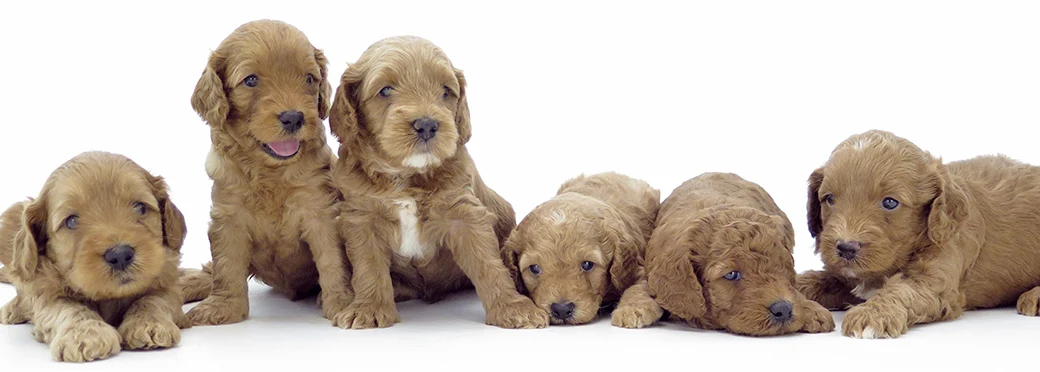
They are known for their low-shedding fleece coats, trainability and people-focused nature, and are available in Miniature, Medium and Standard sizes.
The name Cobberdog comes from the Australian word “cobber” — meaning a trusted friend or mate. A very fitting name for a breed developed to form such a special bond with its people.
In January 2012, the Australian Cobberdog was officially recognised by the Master Dog Breeders and Associates (MDBA) as a Pure Breed in Development.
The MDBA maintains the official Australian Cobberdog breed registry, helping to protect the breed’s future through documented pedigrees, careful record keeping and breed standards designed to promote consistency across generations.
Every registered Australian Cobberdog has an MDBA pedigree that records its ancestry, giving breeders valuable information to make thoughtful and responsible breeding decisions.
This careful record keeping is an important part of developing and protecting the Australian Cobberdog for generations to come.
What is the difference between an Australian Cobberdog and an Australian Labradoodle?
What is the difference between an Australian Cobberdog and an Australian Labradoodle?
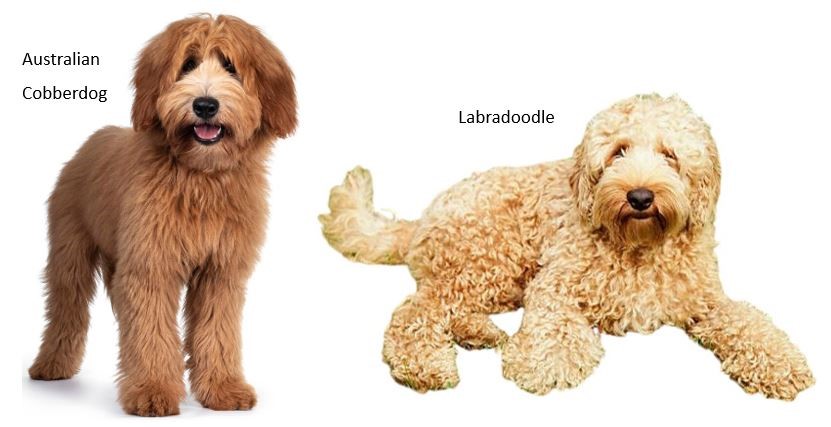
Although the Australian Cobberdog and Australian Labradoodle share some ancestry, they are now distinct breeds with different breeding paths and standards.
The Australian Cobberdog was developed with a particular focus on consistent temperament, health, low-shedding fleece coats and suitability for therapy and assistance work. Australian Cobberdogs registered with the MDBA have documented pedigrees, allowing breeders to carefully follow generations of health, temperament and ancestry.
Today, the Australian Cobberdog has its own breed standard and identity — it is not simply another name for an Australian Labradoodle.
Discover the history of the Australian Cobberdog and how the breed developed
Are Australian Cobberdogs hypoallergenic?
Are Australian Cobberdogs hypoallergenic?
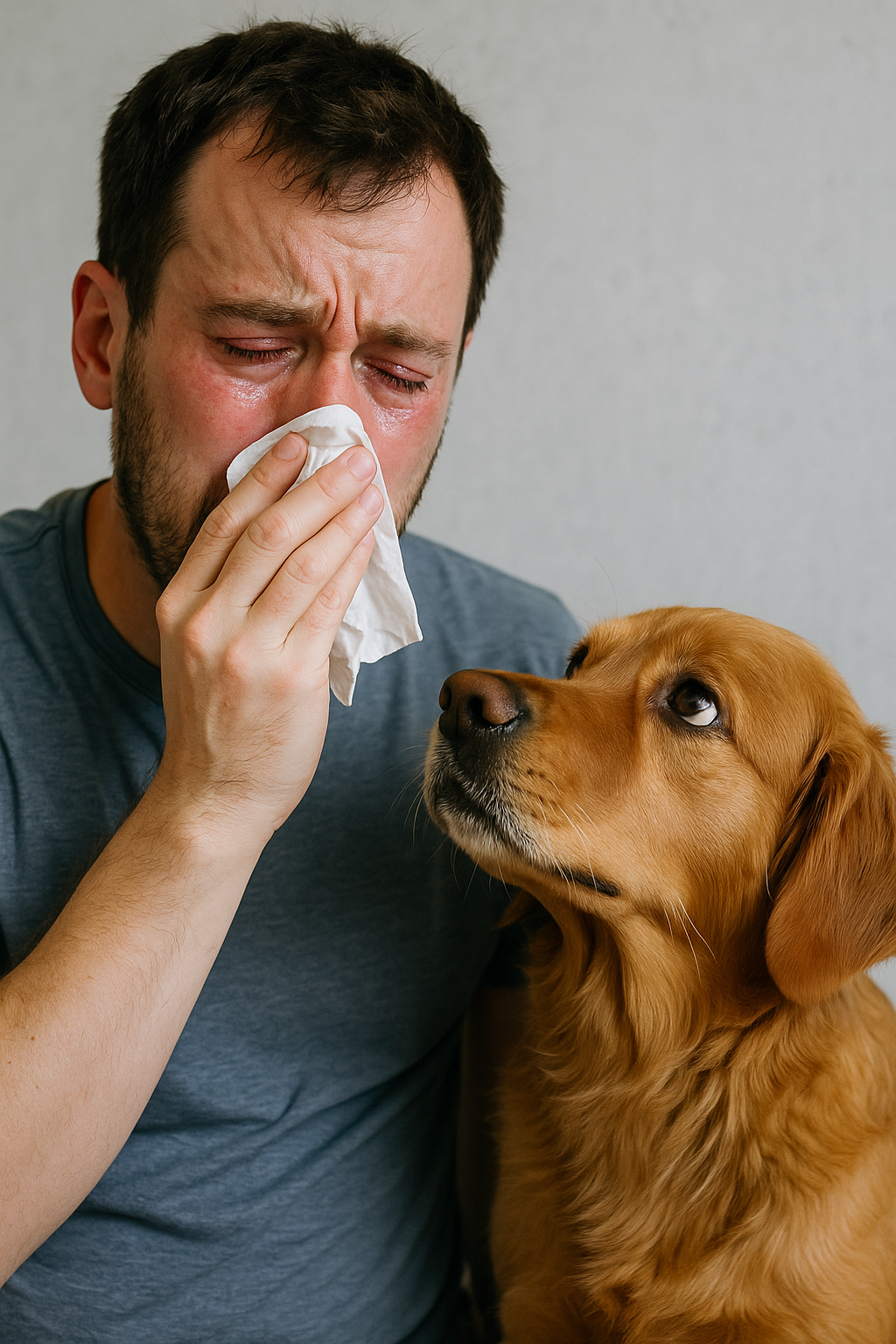
Australian Cobberdogs are known for their low-shedding fleece coats and are often well tolerated by people who experience allergies to other dogs. However, no dog can be guaranteed to be completely hypoallergenic, as people can react to different allergens, including dander and saliva.
At KooeeKeis, we offer families a simple way to test their sensitivity before committing to a puppy.
Simply place a clean T-shirt in a zip-lock bag and post it to:
KooeeKeis Australian Cobberdogs
PO Box 686
York, Western Australia 6302
Keith and Isi will place your T-shirt on our dogs’ bedding for approximately one week before returning it to you. You can then wear the shirt at home and see whether you experience an allergic reaction.
While this cannot guarantee how you will respond to an individual puppy, it can provide a useful real-world indication before taking the next step.
Do Australian Cobberdogs Shed?
Do Australian Cobberdogs Shed?
Yes — all dogs shed to some degree, but one of the lovely features of the Australian Cobberdog is its very low-shedding fleece coat.
Unlike many breeds that leave hair on your clothes, furniture and floors, Australian Cobberdogs shed very little. Living with our own dogs, it is quite unusual for us to find dog hair on our clothing — something many Cobberdog families particularly appreciate.
Their beautiful fleece coat does, however, continue to grow and requires regular brushing and grooming to keep it healthy, comfortable and free from knots and matting.
So, while we prefer to say low shedding rather than non-shedding, you certainly shouldn’t expect the tumbleweeds of dog hair that can come with many other breeds!
Learn more about Australian Cobberdog coat types and grooming →
What is the temperament of an Australian Cobberdog?
What is the temperament of an Australian Cobberdog?
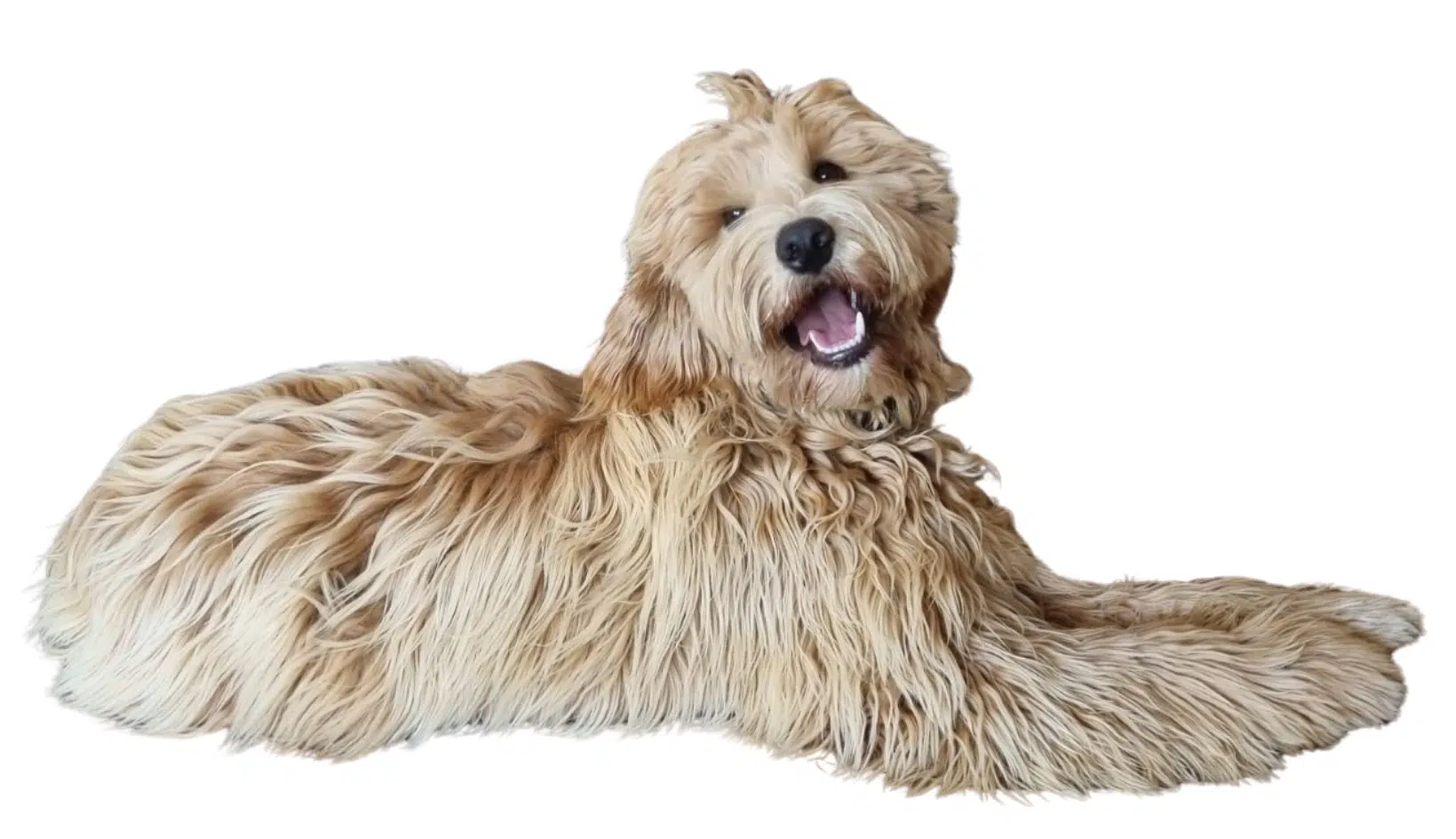
The Australian Cobberdog is known for its gentle, intuitive and people-focused temperament. They form strong bonds with their families and have a remarkable ability to tune in to human emotions — often seeming to know when someone needs a little extra companionship.
Intelligent, affectionate and eager to please, they are quick learners who respond beautifully to gentle, positive training. Their natural sensitivity and connection with people are also among the qualities that make the breed so well suited to therapy and assistance work.
At KooeeKeis, we nurture these qualities from birth by raising our puppies within our home and as part of our family, with careful socialisation and individual temperament assessment.
Perhaps the simplest way to describe an Australian Cobberdog is a dog that doesn’t just live with its family — it genuinely wants to be part of it.

Are Australian Cobberdogs good family dogs?
Are Australian Cobberdogs good family dogs?
Absolutely — being part of a family is where an Australian Cobberdog truly shines.
Cobberdogs are affectionate, gentle and very people-focused. They form strong bonds with their families and love being involved in everyday life — whether that means joining you on an adventure, playing with the children, or simply curling up nearby while the family relaxes.
One of the breed’s most endearing qualities is its intuitive nature. Australian Cobberdogs often seem remarkably aware of how their people are feeling and will naturally seek connection and offer quiet companionship.
They are not a breed that is happiest spending long periods alone or separated from family life. They thrive on human connection, companionship and being included.
At KooeeKeis, we often say we aren’t simply breeding a beautiful dog — we are raising a new member of your family.

Are Australian Cobberdogs good with children?
Are Australian Cobberdogs good with children?
Are Australian Cobberdogs Good with Children?
Australian Cobberdogs are known for their gentle, affectionate and intuitive nature, which can make them wonderful companions for children. They are people-focused dogs that enjoy being involved in family life and often form very special bonds with the youngest members of their family.
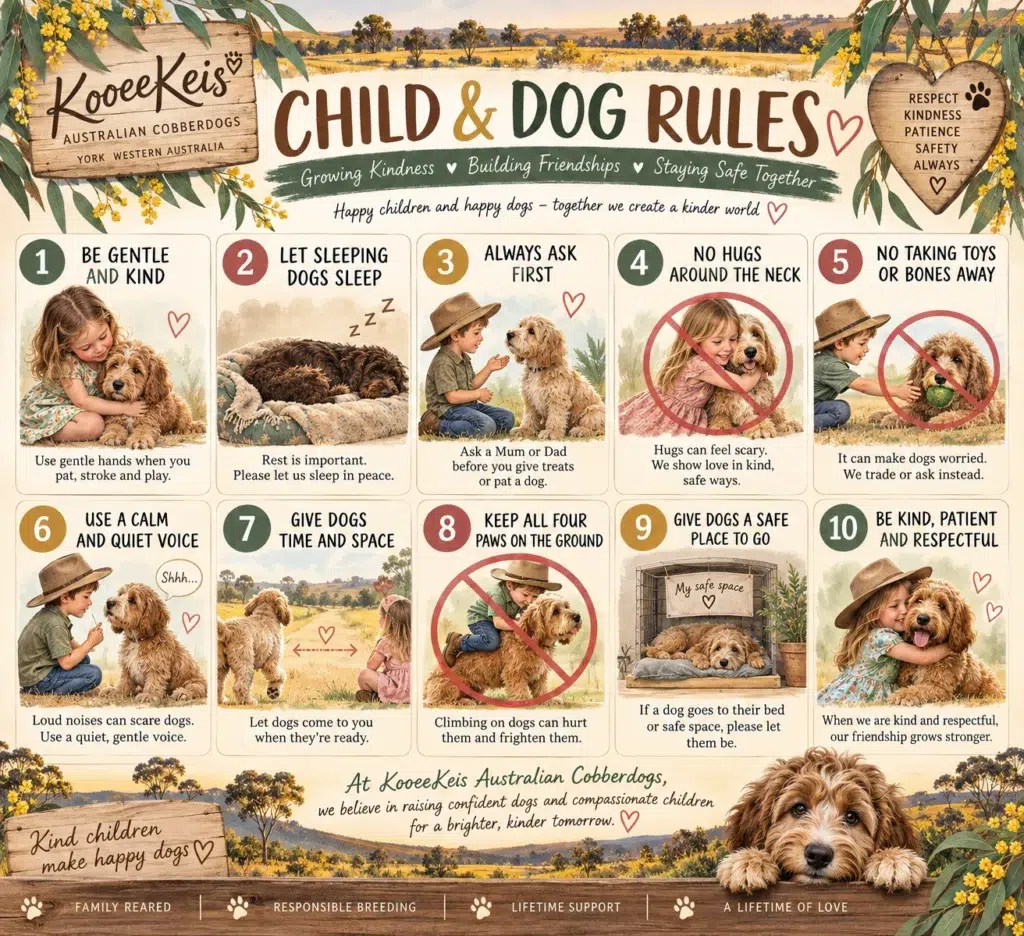
However, a beautiful relationship between a child and a dog is something we teach and nurture. Even the gentlest dog needs to feel safe, respected and understood. Children should learn when a dog needs space, how to play gently, and why sleeping, eating or resting dogs should be left in peace.
At KooeeKeis, our puppies are raised within our home and introduced to everyday family life from an early age, helping them develop confidence and positive experiences with people.
We believe the responsibility goes both ways: we teach our puppies how to live happily with people, and we teach our children how to live respectfully with dogs.
Kind children help create happy, confident dogs — and beautiful friendships can grow from there.
Our Child & Dog Rules below are a simple guide you can share with the whole family.
How much does an Australian Cobberdog puppy cost?
How much does an Australian Cobberdog puppy cost?
A KooeeKeis Australian Cobberdog pet puppy is AU$6,200 (including GST) for families within Australia. Our pricing reflects the extensive health testing, careful breeding, early development, socialisation and preparation that goes into raising each puppy, together with our Lifetime Genetic Health Guarantee and lifetime breeder support.
For our international jet-setting puppies, pricing is individually calculated according to the destination country and its requirements. The puppy’s age at departure, veterinary and export requirements, transport arrangements and the length of time they remain in our care can all influence the final cost.
Wherever one of our puppies is going, our priority remains the same — a beautifully prepared puppy, thoughtfully matched with the right family.
View our current Australian Cobberdog pricing and what is included
Why are Australian Cobberdogs so expensive?
Why are Australian Cobberdogs so expensive?
Breeding an Australian Cobberdog responsibly involves far more than simply putting two lovely dogs together. The price reflects the years of planning, health testing, professional care, education and hands-on work that goes into producing and raising each litter.
At KooeeKeis, every puppy benefits from:
- Comprehensive DNA and genetic health testing of our breeding dogs
- Hip, elbow, structural and temperament assessments before dogs enter our breeding program
- Careful selection of breeding pairs, with the aim that every generation is a little better
- ENS (Early Neurological Stimulation) and ESI (Early Scent Introduction)
- Extensive age-appropriate socialisation, enrichment and confidence building
- Puppies raised inside our family home — never in kennels
- Early foundations in toilet training, crate training, grooming and everyday family life
- Individual personality and temperament assessment, helping us match the right puppy with the right family
- Veterinary care, microchipping, vaccination and MDBA registration
- Our Lifetime Genetic Health Guarantee
- Lifetime breeder support — our relationship doesn’t end when your puppy goes home.
KooeeKeis has also undertaken the Elite Breeder Formula, continuing our education and development as breeders because we believe there is always more to learn and always something we can do better.
When you purchase a KooeeKeis puppy, you aren’t simply paying for the puppy you take home. You are paying for everything that happened before that little puppy was placed into your arms — and the support that remains afterwards.
Learn more about the Elite Breeder Formula
Continuing Education & Breeder Development
At KooeeKeis, we believe a responsible breeder should never stop learning. Over the years we have invested considerable time in breeder education, puppy development, temperament and responsible breeding practices.
Our education, programs and professional affiliations include:
- Elite Breeder Formula – advanced breeder education and development
- Therapy Dogs Australia – Breeder Course – further developing our understanding of raising puppies with therapy and assistance potential
- Puppy Culture – incorporating age-appropriate development, enrichment and socialisation principles
- Badass Breeder Program – additional education in puppy raising, temperament and breeder practices
- Master Dog Breeders & Associates (MDBA) – registered Australian Cobberdog breeders
- RightPaw Verified – independently verified through RightPaw’s breeder verification process
We don’t follow any one program blindly. We continue to learn, question, adapt and bring together the practices we believe give our puppies the very best start in life.
For us, responsible breeding isn’t about collecting badges or certificates. It’s about putting that knowledge into practice with every litter we raise.
How big does an Australian Cobberdog grow?
How big does an Australian Cobberdog grow?
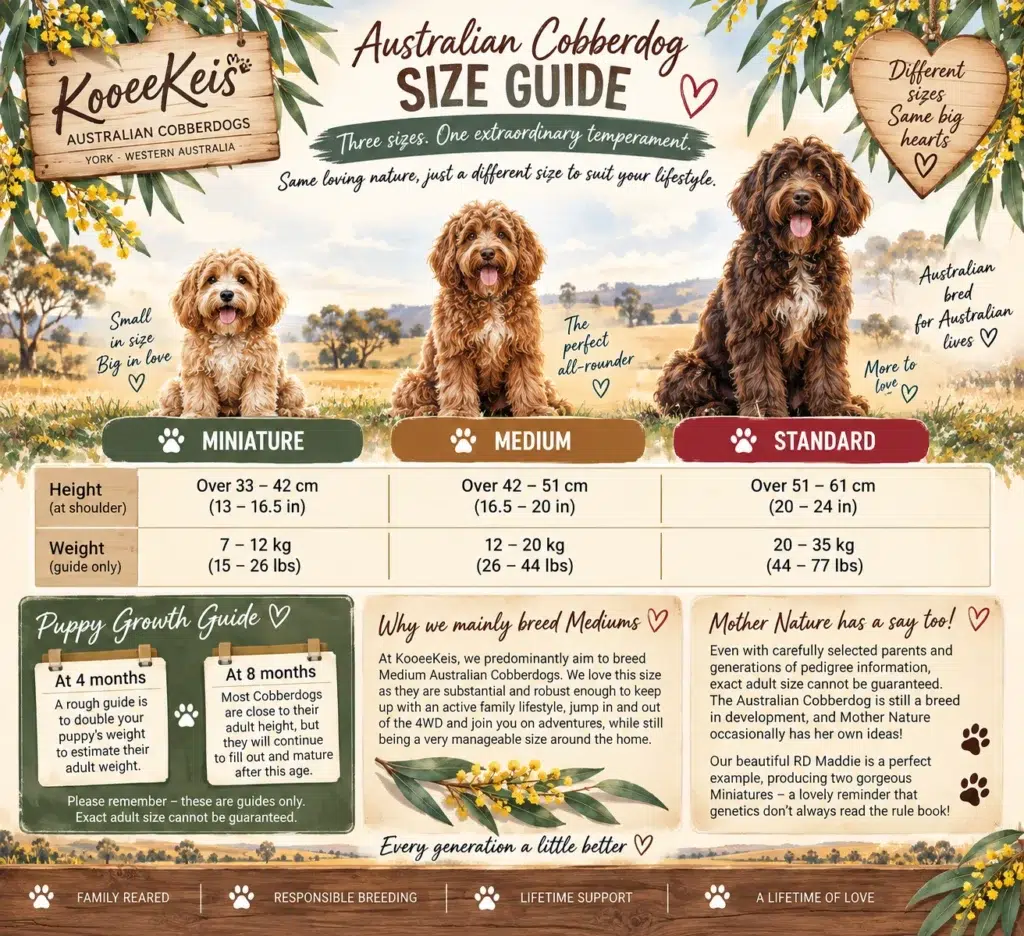
Australian Cobberdogs come in three recognised sizes — Miniature, Medium and Standard. Size is determined primarily by height, measured from the ground to the top of the shoulder (the withers).
At KooeeKeis, we predominantly aim to breed Medium Australian Cobberdogs. We love this wonderfully practical size — substantial and robust enough to enjoy an active family lifestyle, jump in and out of the 4WD and join you on adventures, while still being a very manageable dog around the home.
Of course, Mother Nature occasionally has her own ideas! Even with carefully selected parents and generations of pedigree information, exact adult size cannot be guaranteed. The Australian Cobberdog is still a breed in development, and even experienced breeders cannot always accurately predict where an individual puppy will finish.
Our beautiful RD Maddie is a perfect example. Although Maddie is a Medium, she surprised us by producing two magnificent Miniatures — one of those lovely reminders that genetics don’t always read the rule book!
A handy growth guide: for Medium puppies, doubling their weight at approximately four months can give families a rough indication of eventual adult weight. By around eight months, many Cobberdogs are approaching their adult height, although they will continue to mature and fill out afterwards. It is always an estimate rather than a promise.
See our Australian Cobberdog Size Guide below for the Miniature, Medium and Standard size ranges.
How much grooming does an Australian Cobberdog need?
How much grooming does an Australian Cobberdog need?
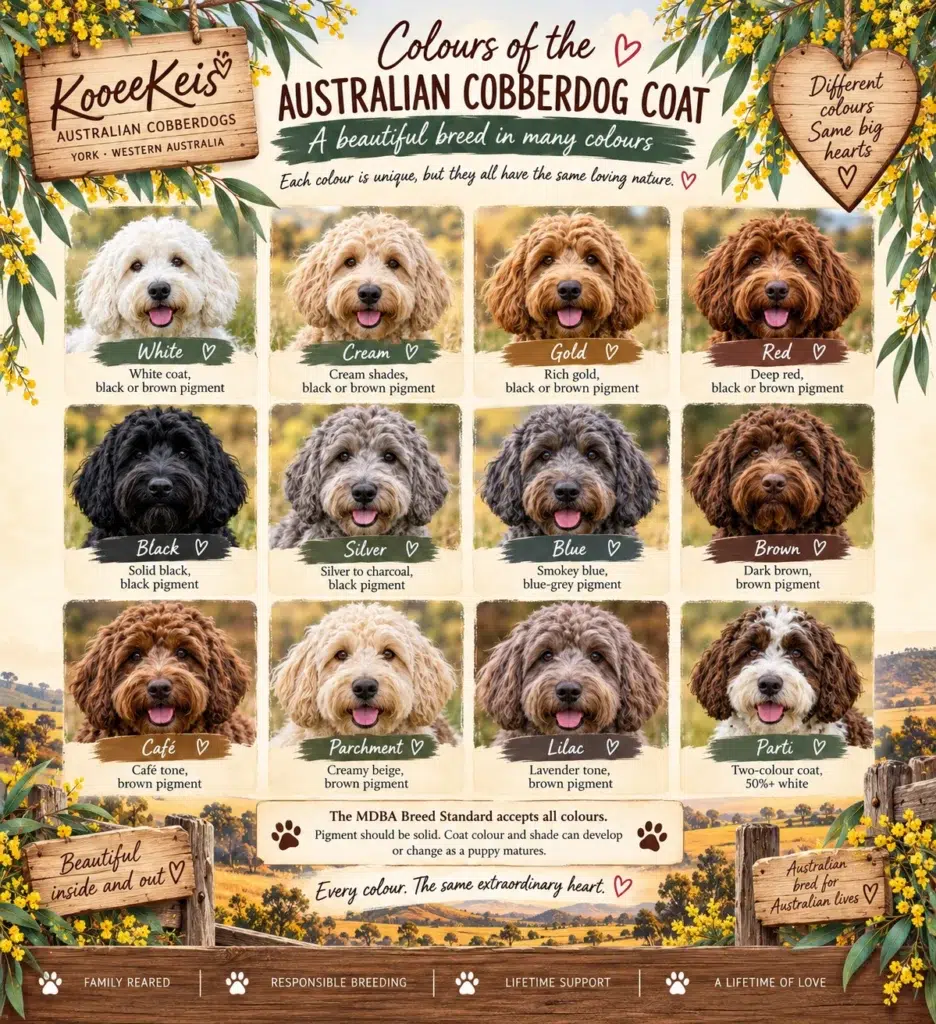
The Australian Cobberdog’s beautiful, low-shedding fleece coat is one of the breed’s lovely features — but low shedding doesn’t mean no grooming.
Their coat continues to grow and needs regular brushing and combing to prevent knots and matting. How often will depend on the length of coat you choose to maintain, your dog’s lifestyle and whether they enjoy collecting half the Australian countryside on their adventures! Longer coats naturally require more attention.
At KooeeKeis, we introduce our puppies to brushing, bathing, drying, clipping and handling from an early age, helping grooming become a normal and positive part of life rather than something to fear.
Many families choose a practical shorter trim because it is easier to maintain while still keeping that beautiful Cobberdog look. The MDBA currently suggests around 7–12 cm on the body as an ideal maintained length, with shorter practical trims also appropriate for family and working dogs.
Regular grooming isn’t just about looking beautiful — it’s part of keeping your Cobberdog comfortable, healthy and happy.
Learn more about Australian Cobberdog coat types and grooming
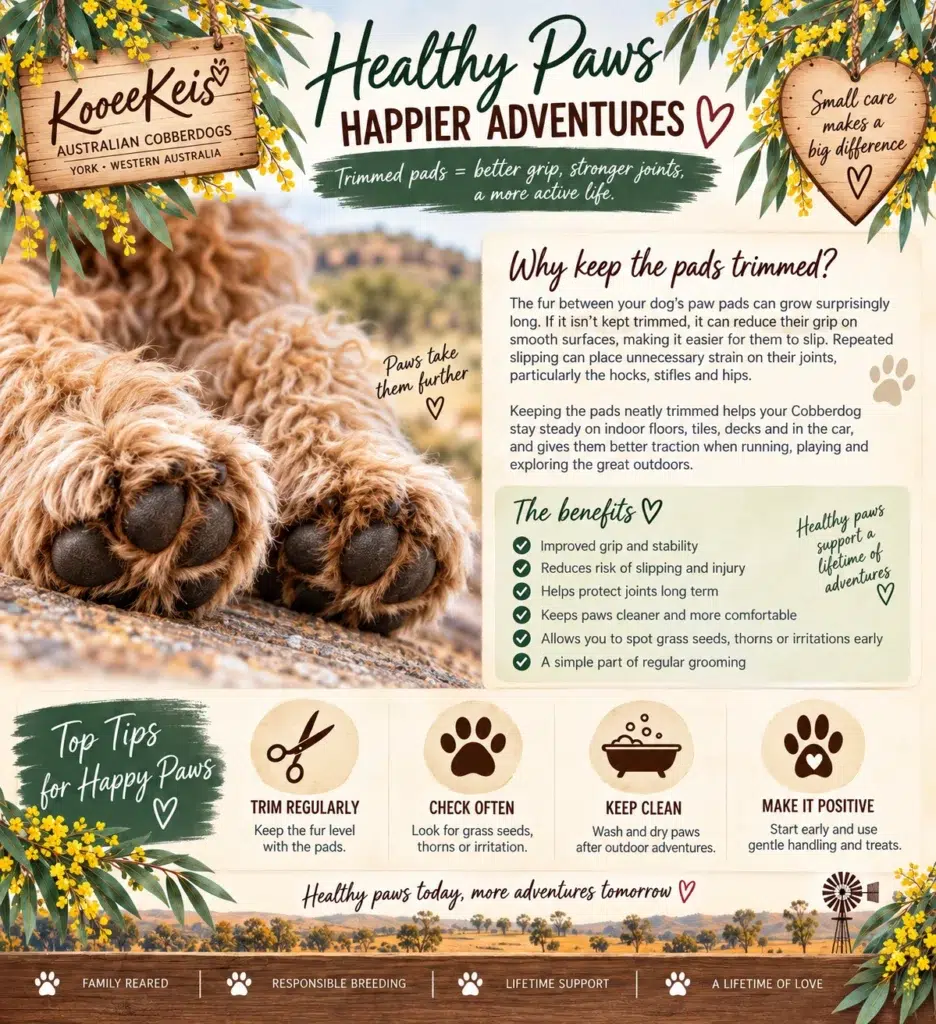
Don’t Forget the Paw Pads
Keeping the hair between your Cobberdog’s paw pads neatly trimmed is an important part of regular grooming. When this hair becomes long, it can cover the pads and reduce the natural grip they provide, particularly on tiles, polished floorboards and other slippery surfaces.
A dog that is continually slipping may compensate by changing the way it stands or moves, which can place unnecessary strain on muscles and joints. This is particularly important for growing puppies and older dogs.
At KooeeKeis, we recommend checking the feet regularly and keeping excess hair trimmed level with the paw pads, rather than digging deeply between the pads.
Think of those little pads as your Cobberdog’s built-in non-slip shoes — we just need to make sure the fluff doesn’t cover the tread!
What health problems can Australian Cobberdogs have?
What health problems can Australian Cobberdogs have?
The Australian Cobberdog has been developed with a strong emphasis on health, sound structure and genetic diversity, but like every breed, no dog can be guaranteed never to develop a health problem.
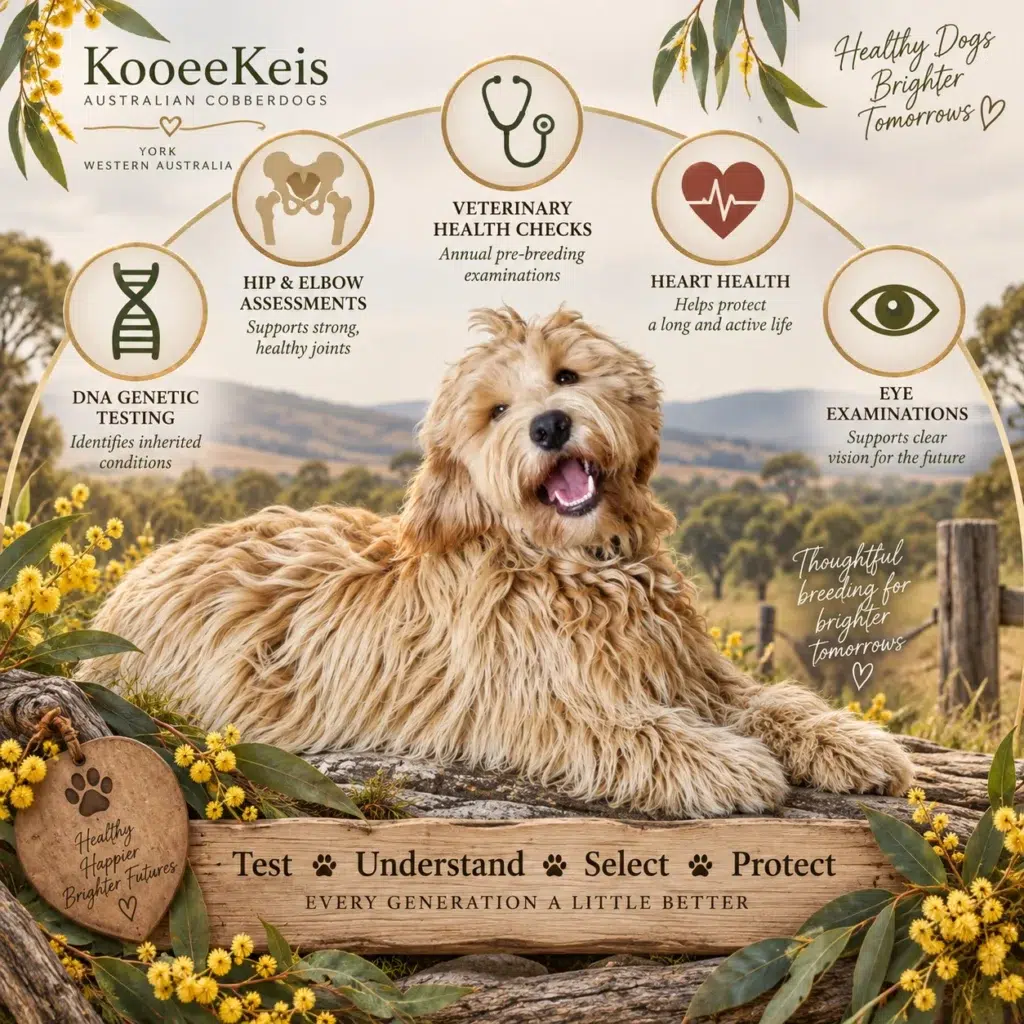
Some of the areas responsible Australian Cobberdog breeders monitor include hips and elbows, knees (patellas), eyes, heart health and inherited genetic conditions. Many hereditary diseases can now be identified through DNA testing, allowing breeders to make informed mating decisions and greatly reduce the risk of producing affected puppies.
At KooeeKeis, our breeding dogs undergo comprehensive DNA screening together with physical and structural health assessments. We look beyond a simple “DNA clear” result because good health involves the whole dog — genetics, joints, structure, temperament and overall wellbeing.
We are also proud to offer our families a Lifetime Genetic Health Guarantee. Our guarantee covers serious inherited genetic conditions and reflects the confidence we place in our health testing, careful selection of breeding dogs and responsible mating decisions.
Our philosophy is simple: we cannot promise that a dog will never become unwell, but we can do everything reasonably available to us as breeders to reduce preventable inherited disease.
Learn more about our Lifetime Genetic Health Guarantee
“KooeeKeis Australian Cobberdogs is proud to offer a Lifetime Genetic Health Guarantee — something that goes well beyond the limited health-guarantee period commonly offered by many breeders.”

What health testing should an Australian Cobberdog breeder perfrom?
What health testing should an Australian Cobberdog breeder perform?
A responsible Australian Cobberdog breeder should never simply put two lovely dogs together and hope for the best.
Health testing happens before the mating
At KooeeKeis Australian Cobberdogs, we believe responsible breeding means looking beyond what we can see on the outside. A dog may appear perfectly healthy but still carry inherited conditions that could potentially be passed to future generations.
That is why health testing and careful selection of breeding dogs are such important parts of our breeding program.
DNA Genetic Testing
Before breeding, Australian Cobberdogs should undergo comprehensive DNA testing for genetic conditions relevant to the breed.
DNA testing can identify whether a dog is Clear, a Carrier, or At Risk/Affected for particular inherited conditions.
Being a carrier does not automatically make a dog unsuitable for breeding. In a developing breed, removing every carrier from the breeding population can unnecessarily reduce genetic diversity. Instead, knowledgeable breeders use DNA results when selecting suitable partners so that known genetic conditions are carefully managed.
The important question isn't simply, “Is this dog a carrier?” It is, “Has the breeder understood the result and chosen the mating responsibly?”
Hip and Elbow Testing
These assessments help breeders identify joint abnormalities and make informed decisions about which dogs should contribute to future generations.
Good hips and elbows in the parents cannot guarantee that a puppy will never develop a joint problem — genetics is only part of the picture — but screening breeding dogs gives us valuable information and helps us make better breeding decisions.
Veterinary Health Examination
Health testing isn’t something that should be completed once and then forgotten.
MDBA requires Australian Cobberdog breeding dogs born after 1 July 2024 to undergo a pre-breeding veterinary health check every 12 months, with the results submitted to MDBA.
This allows the dog’s general health and suitability for breeding to continue to be monitored throughout its breeding life.
Eyes, Heart and Other Health Assessments
Depending upon the individual dog, its pedigree and the breeding program, responsible breeders may also undertake additional examinations such as specialist eye and heart assessments.
Health testing should evolve as new information becomes available. If a health concern or genetic marker is identified within the breed, responsible breeders should be prepared to investigate it rather than simply relying on the tests that were available several years ago.
Testing is only half the story
Having a folder full of test results doesn’t automatically make someone a responsible breeder.
Those results need to be understood and used.
Before planning a mating, we consider the health results of both parents, their pedigrees, genetic diversity, temperament, structure and what each dog may contribute to the next generation.
Sometimes an individual dog we hoped would become part of our breeding program doesn’t meet our standards. When that happens, that dog simply doesn’t breed.
For us, breeding isn’t about producing the greatest number of puppies.
It is about making thoughtful decisions that give every new generation the best possible start.
At KooeeKeis, we breed with the future in mind
The Australian Cobberdog is still a breed in development. Every breeding decision we make today contributes to what this wonderful breed will become tomorrow.
Health testing cannot promise that any living animal will never experience illness. What it can do is give responsible breeders valuable information to reduce avoidable risks and make better-informed breeding choices.
That is why health testing, transparency and careful selection sit at the heart of the KooeeKeis breeding program.
Every generation a little better.
Can an Australian Cobberdog be left home alone?
Can an Australian Cobberdog be left home alone?
Yes — but not for long periods as a regular part of their life.
Australian Cobberdogs form very strong bonds with their people. They are social, intuitive dogs that thrive on companionship and being included in everyday family life.
With gentle training and gradual introduction, an adult Cobberdog should learn to feel safe and relaxed when left at home for reasonable periods. In fact, learning that their family can leave and will return is an important life skill.
However, there is a big difference between teaching a dog to be comfortably alone sometimes and expecting them to spend most of every working day by themselves.
Your lifestyle matters
Before welcoming a puppy, it is important to think realistically about what an ordinary week in your household looks like.
If everyone is away from home for long working days, five days a week, with the dog routinely left alone for much of that time, an Australian Cobberdog may not be the right breed for your family.
That doesn’t necessarily mean someone who works cannot have a Cobberdog. Many families successfully arrange their lives around their dog — working from home for part of the week, sharing care between family members, coming home during the day, using a trusted dog walker or arranging suitable daycare.
What matters to us is that your Cobberdog will have the companionship, interaction and involvement in family life that this breed needs to thrive.
Why we ask about this on our Waitlist Application
This is one of the reasons we ask prospective families to complete a Waitlist Application before joining the KooeeKeis waitlist.
We aren’t looking for a “perfect” household. We are trying to understand what everyday life will look like for one of our puppies.
If an application indicates that a puppy would routinely spend very long periods home alone, we will talk openly with the family about their circumstances. Sometimes there is a perfectly workable solution. At other times, we may gently suggest that an Australian Cobberdog isn’t the best match for their current lifestyle.
That’s not about judging a family.
It's about adovating for the puppy that cannot choose its own home.
Puppies need even more of your time
A young puppy cannot simply arrive home and immediately cope with being left alone for hours.
Those first weeks involve toilet training, feeding, socialisation, short training sessions, rest and — very importantly — building security and confidence.
Time alone should therefore be introduced gradually and positively, beginning with very short periods and increasing as the puppy develops.
Planning for those first weeks before your puppy arrives can make an enormous difference.
The right puppy for the right family
At KooeeKeis, our responsibility doesn’t finish when one of our puppies leaves our arms.
We want our Cobberdogs to become genuine members of their families — sharing the ordinary days as well as the adventures.
That is why lifestyle and companionship are every bit as important to us as the colour, coat or sex of a puppy.
The best Australian Cobberdog is the one that is suited to your family - and the family that is suited to them.
Thinking about welcoming a Cobberdog puppy?
Our short video below looks at some of the everyday things to consider before bringing your puppy home
How much exercise does an Australian Cobberdog need?
How much exercise does an Australian Cobberdog need?
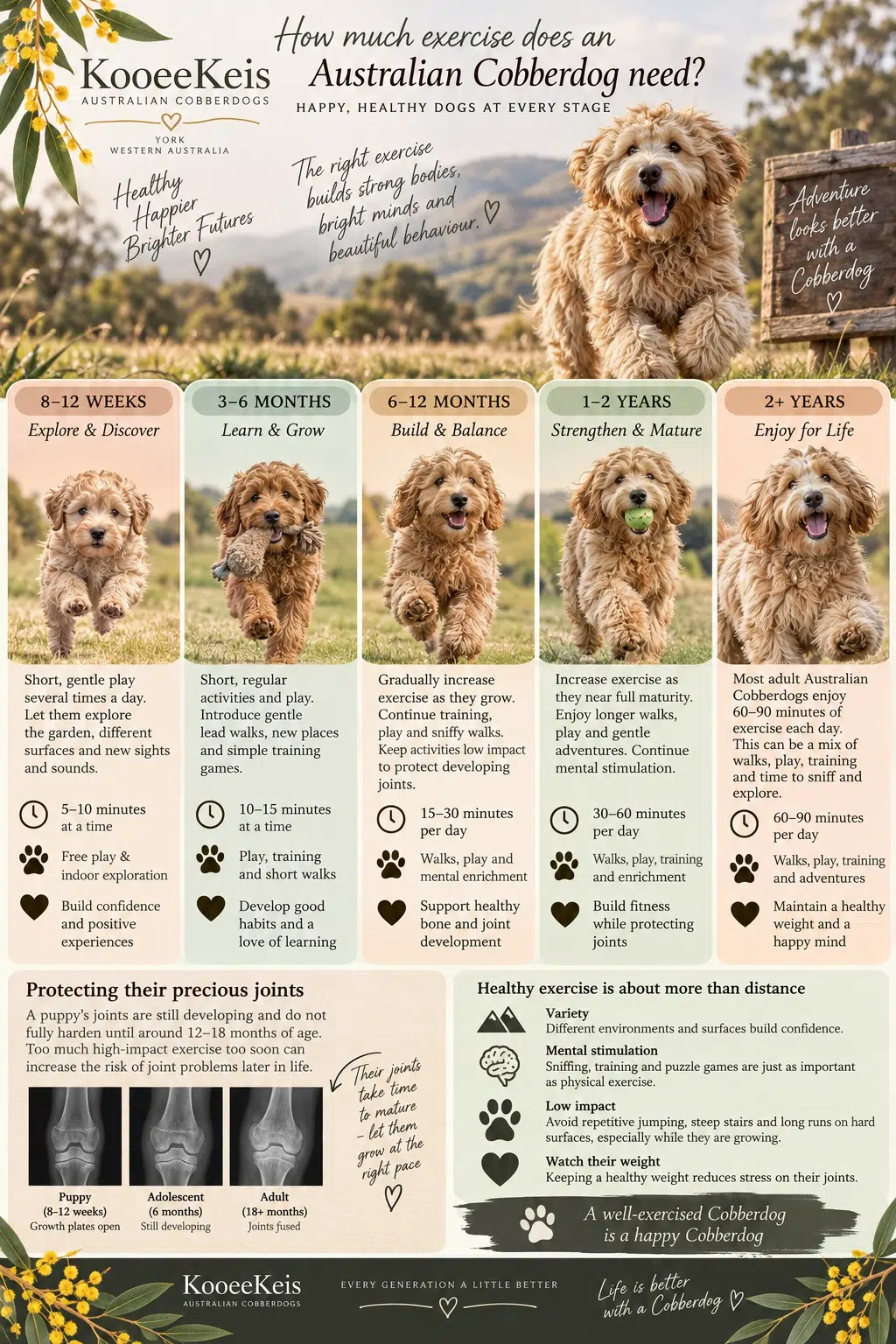
Australian Cobberdogs are active, intelligent dogs that enjoy walks, play, training and adventures with their family. However, the right amount of exercise depends very much on their age.
An adult Cobberdog will generally enjoy around 60–90 minutes of activity throughout the day, depending on their size, health and individual energy level. This doesn’t have to mean 90 minutes of marching around the block! Sniffing, exploring, training, swimming, play and mental enrichment all contribute to a happy, fulfilled dog.
Puppies are Different
More exercise is not necessarily better for a grown puppy
A puppy’s bones and joints are still developing. Their growth plates remain open while they mature, which is why we are particularly careful about repetitive or high-impact exercise during puppyhood.
Rather than long walks or strenuous exercise, we prefer short periods of gentle, age-appropriate activity throughout the day.
Let your puppy explore, sniff, play and learn — with plenty of rest in between.
Protect those growing joints
While your puppy is developing, avoid excessive repetitive exercise such as long forced walks, jogging with you, repeated jumping, continually chasing a ball, lots of stairs or repeatedly jumping in and out of vehicles.
Normal puppy play and free movement are important. The aim isn’t to wrap them in cotton wool — it’s simply to allow their bodies to mature before asking too much of them physically.
As your Cobberdog grows, the length and intensity of exercise can gradually increase.

Exercise for every stage of life
Our guide below gives families an easy starting point for age-appropriate activity, from those first precious weeks through to adulthood.
Every dog is an individual, so their exercise should always be adjusted for their age, health, size, fitness and temperament.
Build them slowly. Protect thos precious joints. There will be plenty of time for adventures
Are Australian Cobberdogs easy to train?
Are Australian Cobberdogs easy to train?
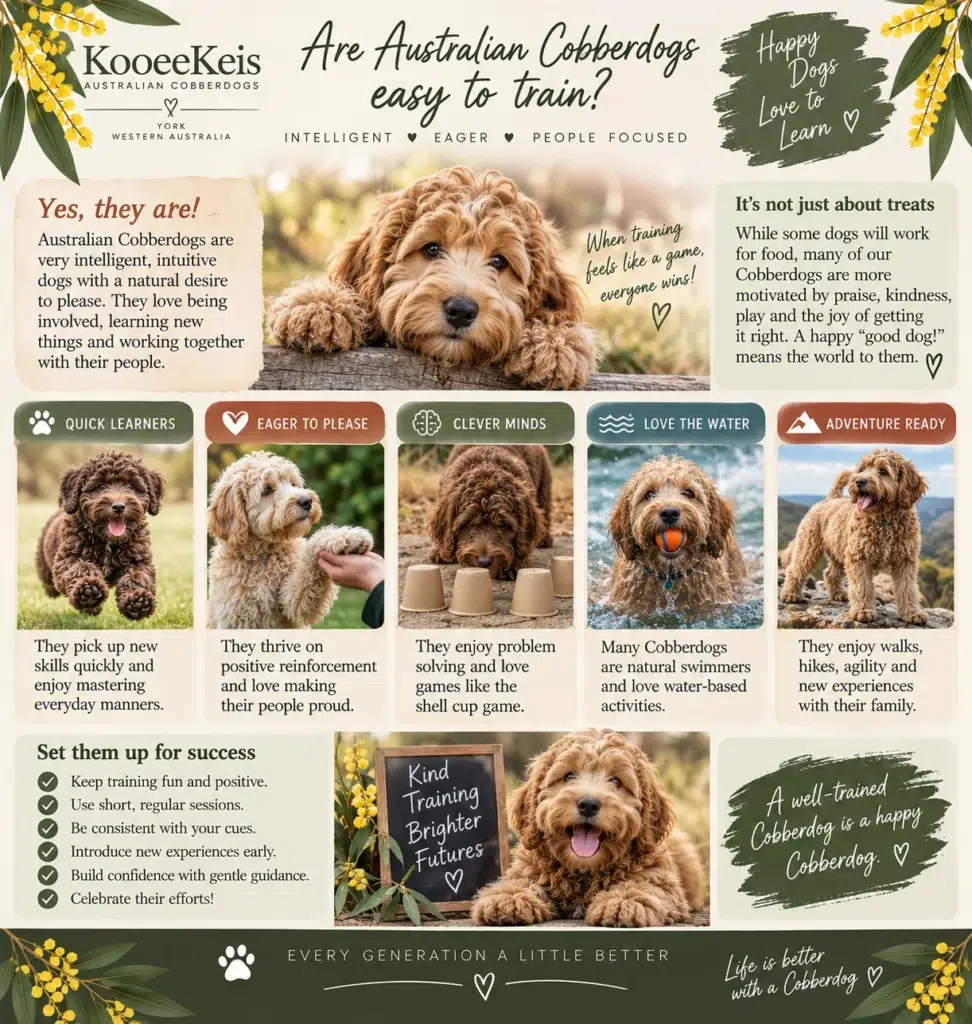
Yes. Australian Cobberdogs are generally very intelligent, eager and people-focused dogs that respond beautifully to positive training.
One of the qualities we particularly love about the Australian Cobberdog is their desire to work with their person. They watch us closely, learn quickly and genuinely seem to enjoy figuring out what we are asking of them.
For many Cobberdogs, training isn’t simply about earning a treat — the interaction itself is rewarding.
They love getting it right
Our own dogs are not particularly food-driven. Of course they enjoy a tasty reward, but what really seems to light them up is our praise when they have understood something and got it right.
A happy voice, affection and an enthusiastic “Good dog!” can mean more to them than what’s in your pocket.
We have built enormous trust with our dogs, and that trust makes training something we do together, rather than something we demand from them.
Clever minds need something to do
Australian Cobberdogs are problem-solvers, so training doesn’t need to be limited to sit, stay and come.
Our dogs love playing the shell cup game, where we hide a treat beneath one of several cups and let them work out where it is. Games like this encourage them to use their nose, memory and problem-solving skills — and they think it is great fun.
Short training sessions, scent games, puzzles and learning new tricks can provide wonderful mental enrichment.
Keep training positive
Because Cobberdogs are sensitive and people-focused, we believe training should be based on trust, encouragement, consistency and positive reinforcement.
Harsh handling isn’t necessary.
We want a puppy to think:
“What are we learning today?”
rather than:
“What will happen if I get this wrong?”
Mistakes are simply part of learning.
Learning starts very young
Training doesn’t suddenly begin when a puppy attends obedience classes.
Long before our puppies leave KooeeKeis, they are already learning about people, household sounds, grooming, handling, toilet routines, crates, toys and the world around them.
Once home, those lessons continue with their new family.
Keep sessions short, make them enjoyable and celebrate the little successes. Five happy minutes of learning can be far more valuable than a long session after your puppy has lost interest.
More than an obedient dog
Training is about much more than teaching commands.
Done well, it builds communication, confidence and trust between you and your Cobberdog.
Whether they’re learning a new trick, finding the hidden treat, splashing in the water, trying agility or simply learning good manners around the home, Australian Cobberdogs usually thrive when their minds are engaged and their people are involved.
Teach with kindness. Praise generously. Make learning fun.
They love getting it right
Are Australian Cobberdogs suitable for therapy or assistance work?
Are Australian Cobberdogs suitable for therapy or assistance work?
Yes. Australian Cobberdogs can be particularly well suited to therapy and assistance work because of their intelligence, gentle nature and strong desire to connect with people.
The breed was developed with temperament and human connection at its heart. Many Cobberdogs are naturally intuitive, attentive and eager to work with their person.
However, not every Australian Cobberdog will be suited to therapy or assistance work. Individual temperament is extremely important, which is one of the reasons we personality test our puppies and carefully match them with their families.
Companion Dogs
Most Australian Cobberdogs are companion dogs — much-loved family members who provide friendship, affection and emotional support simply by sharing everyday life with their people.
A companion dog does not need to be a registered therapy or assistance dog to have an enormously positive impact on someone’s life.
Therapy Dogs
A therapy dog works with its handler to provide comfort, connection and emotional support to other people.
They may visit schools, hospitals, aged-care facilities or other community settings. Therapy work requires a dog with the right temperament — calm, confident, gentle and comfortable interacting with different people and environments.
Assistance Dogs
An assistance dog is different again.
These dogs are individually trained to perform specific tasks that help a person with disability in their everyday life. Depending on the person’s needs, those tasks can vary considerably and require specialised training.
Australian Cobberdogs can have many of the qualities sought for this work, but suitability must always be assessed dog by dog.
Temperament comes first
At KooeeKeis, we never promise that a young puppy will become a therapy or assistance dog.
What we can do is carefully observe and personality test our puppies, then use that information to help identify the puppy whose temperament appears best suited to the family’s needs and intended role.
The right puppy for the right family - and, sometimes, the right puppy for a very special job.
They love getting it right
How do I choose a reputable Australian Cobberdog breeder?
How do I choose a reputable Australian Cobberdog breeder?
Choosing your breeder is every bit as important as choosing your puppy.
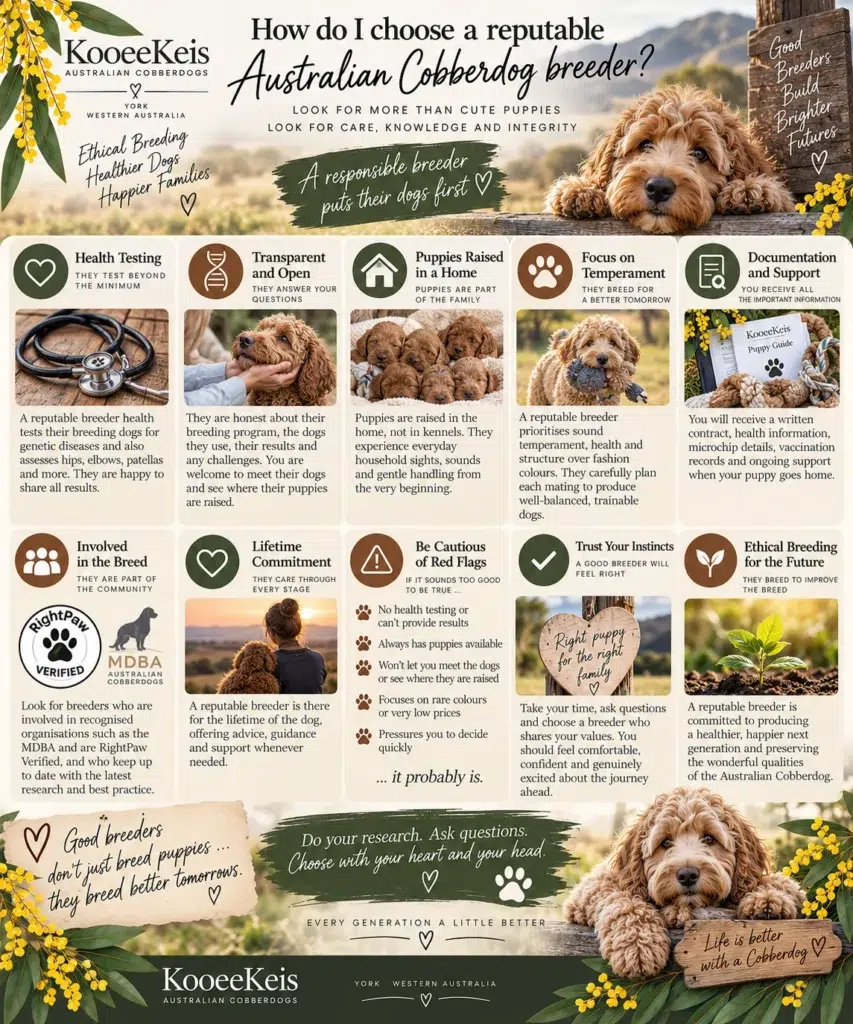
A reputable Australian Cobberdog breeder should be open, knowledgeable and happy to answer your questions. They should willingly explain their breeding program, show you health-testing results and talk honestly about both the strengths and challenges within their dogs and the breed.
Look beyond the puppy photos
Beautiful puppies are easy to fall in love with, but responsible breeding begins long before puppies are born.
Look for a breeder who:
- Completes appropriate DNA, hip, elbow and other health testing on breeding dogs.
- Prioritises health and temperament, not simply colour or appearance.
- Raises puppies in an enriched environment with appropriate socialisation and early training.
- Carefully selects breeding pairs rather than simply mating two available dogs.
- Provides contracts, health information and clear documentation.
- Is prepared to support families throughout the dog’s lifetime.
A good breeder should ask questions about you, too
Don’t be surprised if a responsible breeder wants to know about your family, lifestyle, working hours, other pets and what you hope for in a dog.
The breeder isn’t simply deciding whether you would like one of their puppies — they are deciding whether one of their puppies would be happy living with you.
At KooeeKeis, this is why we ask families to complete our Waitlist Application and why we take puppy matching so seriously.
Transparency matters
You should feel comfortable asking questions, meeting the breeder’s dogs where practical, and discussing how and where puppies are raised.
Be cautious if a breeder is unwilling to provide health-testing information, places considerable emphasis on unusual colours, always seems to have puppies available, or pressures you into making a quick decision.
Take your time
A puppy may share your life for the next 12–15 years or more. Choosing a breeder shouldn’t be rushed.
Do your research. Ask questions. Look beyond the puppy — and choose a breeder whose values match your own.
The right puppy for the right family - and, sometimes, the right puppy for a very special job.
They love getting it right
Are Australian Cobberdogs a recognised pure breed?
Are Australian Cobberdogs a recognised pure breed?
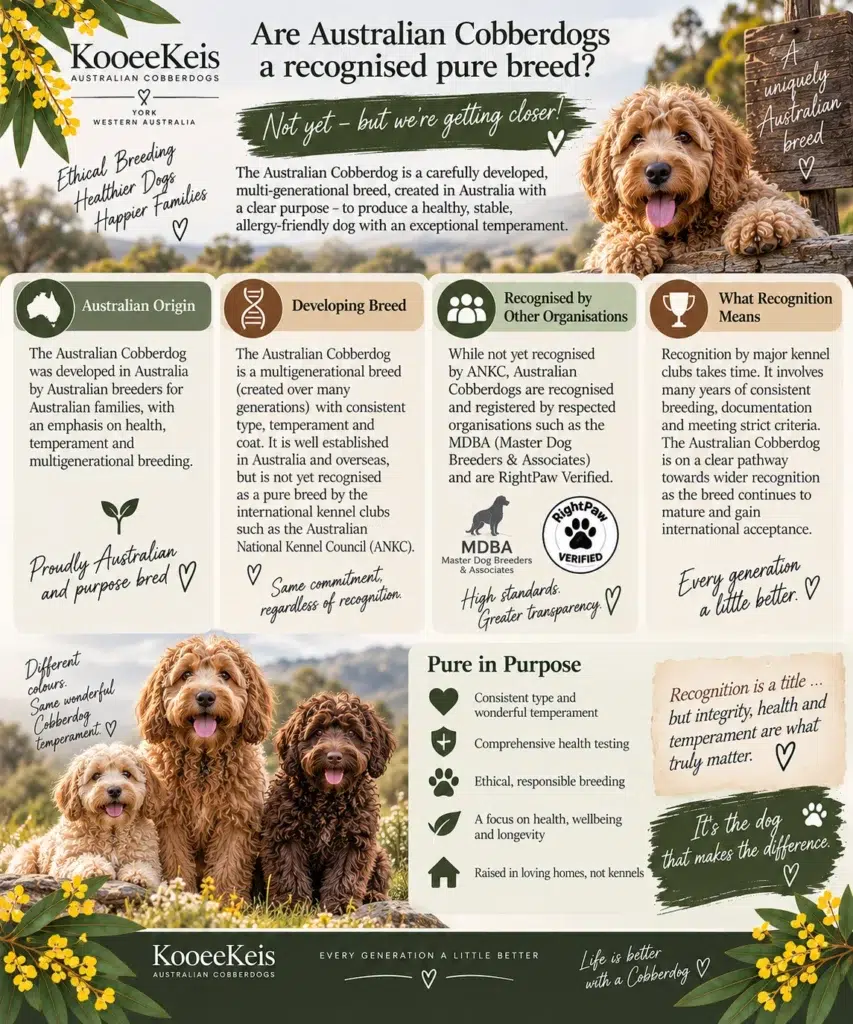
Not yet. The Australian Cobberdog is a developing breed with generations of planned breeding behind it, workng towards formal purebred recognition.
The Australian Cobberdog was developed in Australia with a very specific purpose: to create a healthy, predictable, people-focused dog with the temperament and qualities needed to be an exceptional companion and potentially undertake therapy or assistance work.
What does"breed in development" mean?
Becoming a formally recognised pure breed doesn’t happen overnight.
It requires generations of documented breeding to establish consistency in temperament, health, structure and breed type, while maintaining sufficient genetic diversity for the future.
The MDBA has a formal pathway for developing breeds. Its Foundation Registry records ancestry, health and temperament while a breed develops; breeds can then progress through the Intermediate Registry before ultimately becoming eligible for the General Stud Registry used for MDBA-recognised pure breeds.
Why are pedigrees still important?
Although the Australian Cobberdog has not yet achieved formal purebred recognition, responsible breeders don’t simply breed any two Cobberdogs together.
Pedigrees allow us to follow generations of ancestry and make informed decisions about health, temperament, genetic diversity and future breeding combinations.
MDBA also has specific health requirements for registered Australian Cobberdog breeding dogs, including DNA testing and hip and elbow assessment, with annual pre-breeding health checks applying to breeding dogs born after 1 July 2024.
Every generation a little better
At KooeeKeis, we see being part of a developing breed as both exciting and a responsibility.
The decisions breeders make today will help shape the Australian Cobberdog of tomorrow. That is why we place such importance on health testing, temperament, careful pedigree selection and genetic diversity.
Recognition may be the destination, but producing healthy, wonderful dogs must always be the priority along the way.
The right puppy for the right family - and, sometimes, the right puppy for a very special job.
They love getting it right
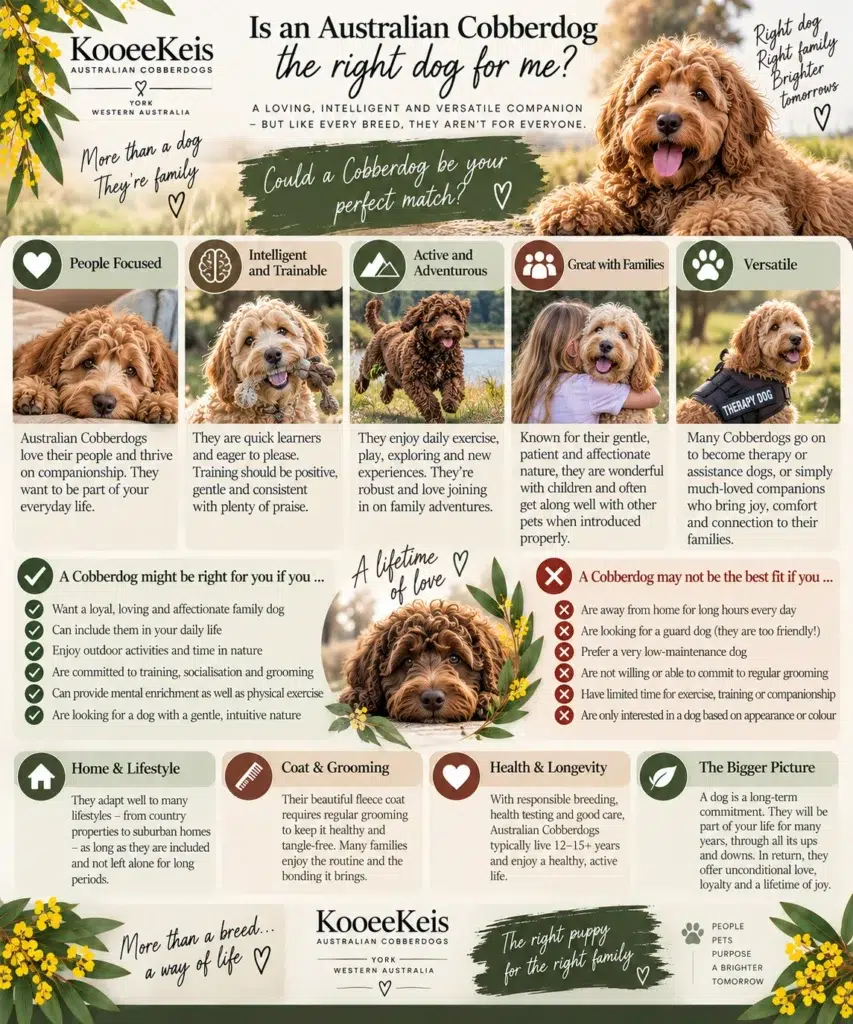
Is an Australian Cobberdog the right dog for me?
Is an Australian Cobberdog right for me?
Australian Cobberdogs are affectionate, intelligent and people-focused dogs, bred to form strong connections with their families. They thrive when included in everyday life and are happiest in homes where they receive plenty of companionship, positive training, mental stimulation and regular exercise.
Their gentle, intuitive nature can make them wonderful family companions, and some go on to therapy or assistance roles. However, they are not a low-maintenance breed. Their fleece coat requires regular grooming, and their strong desire for human company means they are generally not suited to being left alone for long periods every day.
Choosing an Australian Cobberdog should be about much more than size, colour or appearance. Temperament, lifestyle and the right family match come first.
At KooeeKeis Australian Cobberdogs, our philosophy is simple: the right puppy for the right family.
The right puppy for the right family - that's where a beautiful life together begins